A collaborative and ever-growing AI community
Hugging Face has grown rapidly, with over 1 million active users each month.
Creating an environment where knowledge about AI can be freely shared
📂Resource Sharing: upload models and collaborate on updates
📜Collaboration: work together on a project
✏️Education and Support, such as tutorials and articles
Getting to Know Hugging Face
My friends, exchanging ideas and growing together definitely requires a special space and platform, doesn’t it? The same goes for the AI community—having a credible and trusted platform allows its members to share, learn, and grow together.
Let’s get to know Hugging Face better!.... It’s not just a cute name; it’s the largest and most active gathering place for the AI community in the world 🤗.
Why it was created?
Founded in New York by Clément Delangue, Julien Chaumond, and Thomas Wolf, the company initially focused on an interactive chatbot app aimed at teenagers. It utilized natural language processing (NLP) technology.
Recognizing the tremendous potential of machine learning and wanting to build a platform where researchers, developers, and enthusiasts could share ideas,
With a simple yet powerful vision—to make AI more accessible and understandable to everyone—these chatbot models were made open-source. And in 2018, the Transformers library was released, marking a major turning point for the AI community.
The Transformers library works by providing fast and easy access to pre-trained Transformer-based models (such as BERT, GPT, T5, and RoBERTa).
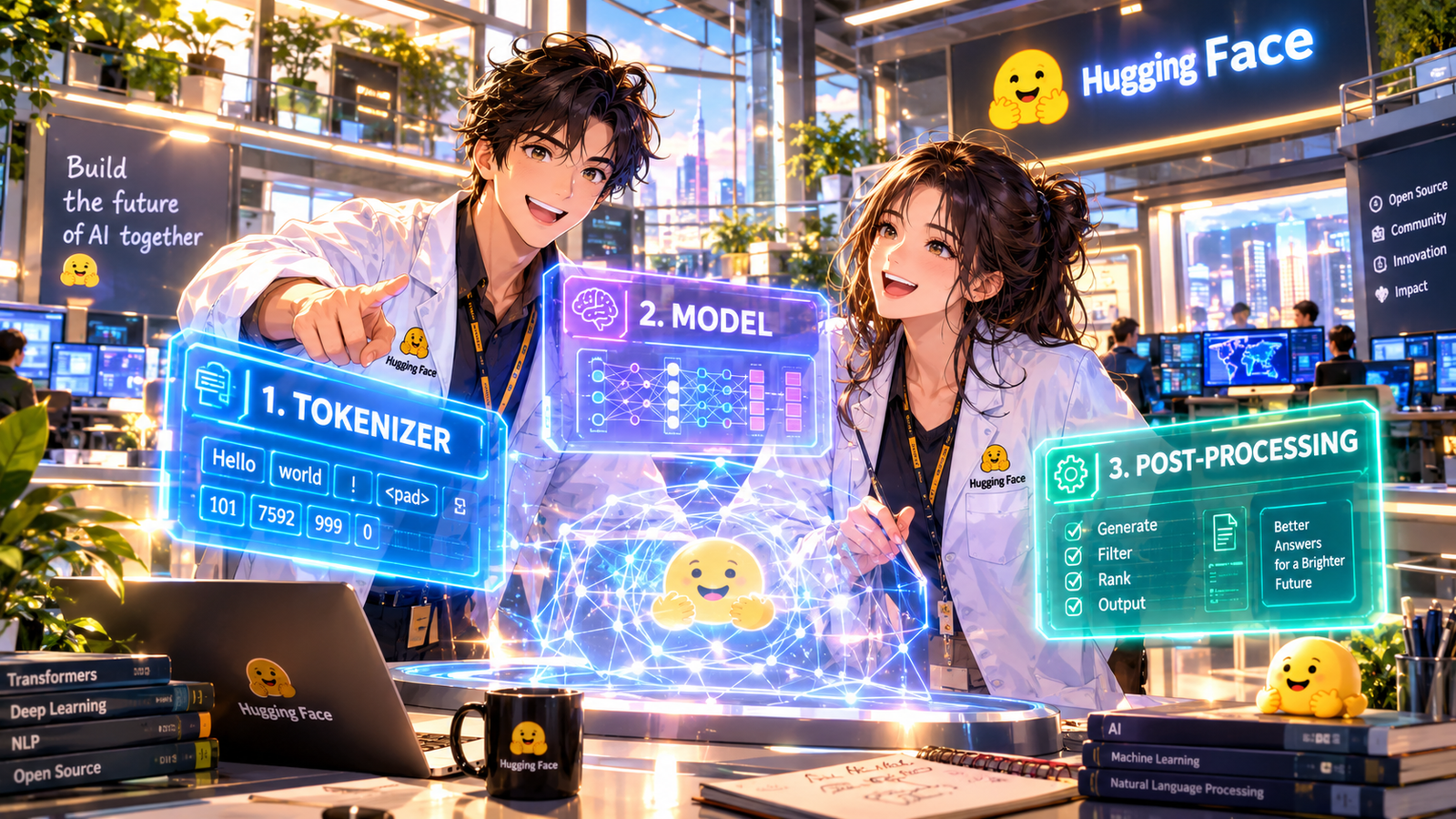
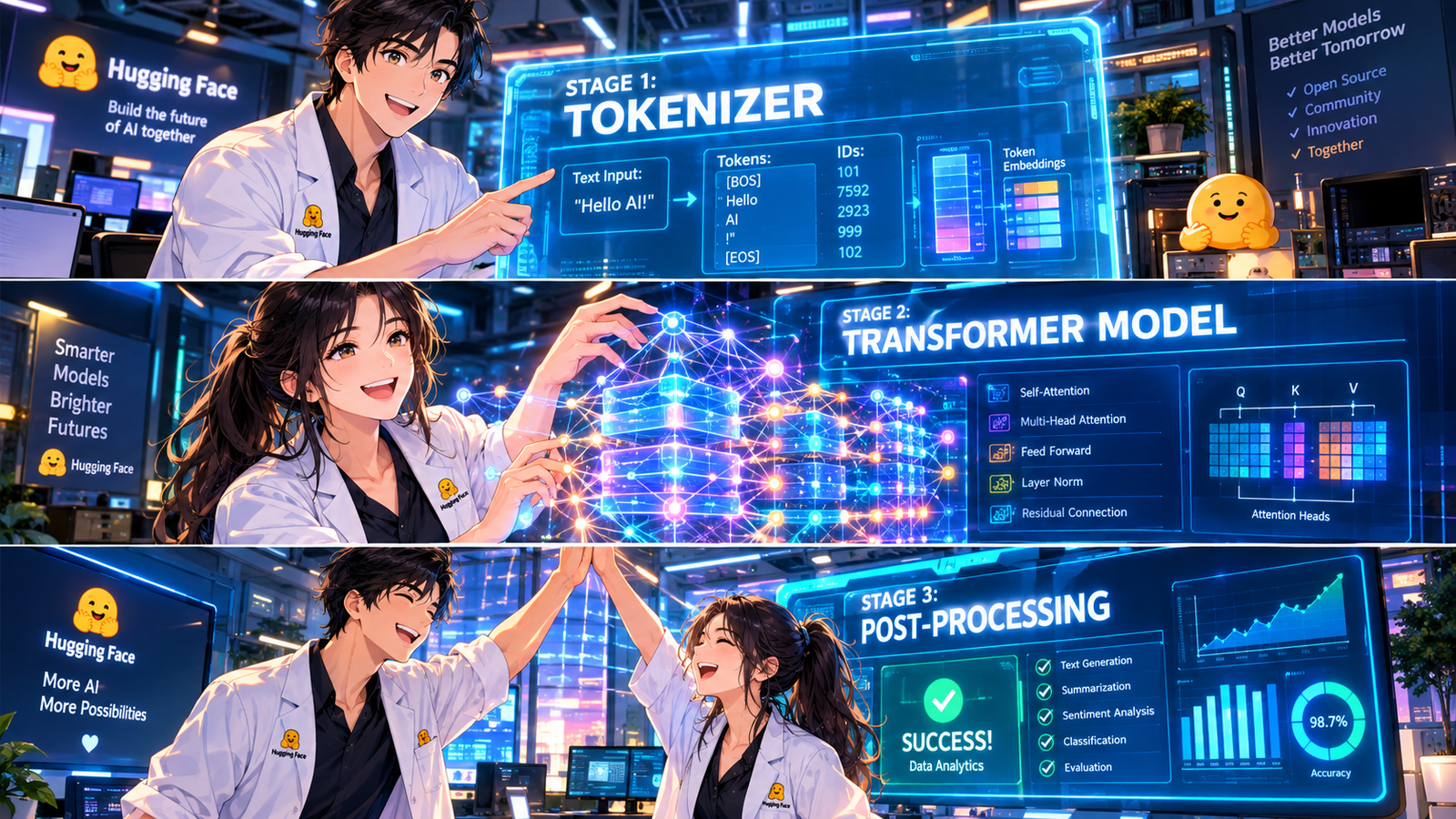
Broadly speaking, this library’s workflow is divided into three main stages:
Input Text ──> [1. Tokenizer] ──> [2. Model] ──> [3. Post-Processing] ──> Prediction Results
For those of you who don’t want to get overwhelmed by long Python code, let’s first imagine how Hugging Face AI works—just like a process in a restaurant kitchen—through these three exciting stages!
1. Tokenizer
Converting Text into Numbers (The “Chop and Prepare” Process)
Computers are, after all, just computers—they don’t understand human language. In this first stage, the tokenizer’s job is to break down our input sentences into small word fragments (called tokens), then convert each word into a unique numerical code. Think of it like a chef cutting meat and vegetables into small pieces so they’re ready to be cooked.
1️⃣Tokenization: Text is broken down into small pieces called tokens (which can be words or sub-words).
2️⃣Mapping: Each token is converted into a unique index number based on the model’s built-in vocabulary.
2️⃣Main Function: Returns tensors (matrix representations of numbers) that are ready to be fed into the model’s neural architecture.
2. Model
Core Process & Attention Mechanism (Cooking & Seasoning)
Once the text is converted into numbers, it enters the AI’s “brain”—the Transformer Model. Here, there’s an advanced technology called “Self-Attention.” The AI doesn’t just read words one by one; it examines the relationships between all the words at once to understand the context. For example, the AI can distinguish between the word “bisa,” which means “can,” and “bisa” as in “snake.” It’s like the cooking process in a pan, where all the spices infuse into each other and blend together to create the perfect flavor.”
1️⃣Self-Attention Mechanism: The model doesn’t just read words one by one in sequence; instead, it examines the relationships between all the words in a sentence simultaneously. This allows the model to understand context (for example, the word “bisa” can mean “can” or “snake venom” depending on the sentence).
2️⃣Hidden States: The model generates a mathematically rich vector representation of the input text.
In short, after receiving tokens from the Tokenizer, the Model component processes the data using a neural network architecture.
It can be said that this is where the strength of Transformer technology lies.
3. Post-Processing / Head
Generating Output (Plating / Presentation)
The final step is Post-Processing. The output from the model is actually still in the form of complex statistical numbers. At this stage, those numbers are organized and converted back into a human-readable format. If the task is sentiment analysis, the AI will generate the following text output: “Positive Sentiment, 99% Accuracy.” Think of it like a restaurant: this is the stage where food is arranged on a beautiful plate (plating) before being served to customers.
1️⃣Text Classification: Converting vectors into label predictions (e.g., Sentiment Analysis → Positive/Negative).
2️⃣Text Generation: Predicting the most logical next word to continue a sentence (as in ChatGPT).
3️⃣Question Answering: Determining the position of a word within the text that serves as the answer to a question.
The key point is that the raw output from the model is then routed to a specific “Head,” depending on the AI task you want to complete.
This is how Hugging Face summarizes the three complex processes above into a single, ready-to-use function called a pipeline. With just a few lines of Python code, this library automatically downloads the model, performs tokenization, and displays the results.
Friends, to date, Hugging Face has grown rapidly, with over 1 million active users every month. This includes independent researchers, students, industry professionals, and even major companies like Google and Microsoft, which use the platform to test and share their AI models.
Hugging Face is proof that technology can serve as a bridge between individuals and innovative ideas. Thanks to its strong, active community, the platform has successfully created a productive and mutually supportive AI ecosystem.
So, are you interested in joining? 🤗
Copyright 2026 All rights reserved