Isi
AI isn’t just simple chatbots anymore; it’s evolved into machines capable of making complex decisions on their own. The big question now is, how do we ensure these machines stay safe and useful?

Enter "AI Alignment," where philosophers and social scientists act as unseen guardians to keep AI in check.
Read more
Isi
Marcus believes in hybrid architectures combining symbolic reasoning with neural networks—not just bigger Transformers.

He envisions an AI like the computer in Star Trek: “You ask it a question, and it gives you an answer you can trust.”
Isi
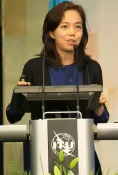
“Human-Centered AI” framework has three concentric circles: individuals (dignity, autonomy, privacy), communities (workers, creators, collaboration), and society (employment, governance, social structures). Fei-Fei Li advocates that AI should be human-centered, not technology-centered. 🤝

Fei-Fei Li is best known for creating ImageNet—the dataset that truly launched deep learning in 2012

Isi
Hassabis’s vision was never just about “playing chess” or “chatting.” In 2024, he won the Nobel Prize in Chemistry

Regarding AI, he offered a specific timeline for AGI: “Around 2030, plus or minus a year.” But he emphasized that it won’t be a single moment but a gradual process. He proposed his own "Einstein Test".
Isi
Sutskever's work has been instrumental in advancing natural language processing (NLP) capabilities through groundbreaking models like GPT-3.

He envisions a future where machines can understand human speech and text with near-perfect accuracy, leading to seamless communication between humans and computers. 📚
Isi

AI, Consciousness, and the Soul

:
You're having a heart-to-heart with a chatbot. It asks how your day was, responds with empathy, and makes you feel heard. Is that genuine connection, or is it just an incredibly sophisticated parlor trick?😄

This is exactly what philosopher Amanda Askell—who literally gets paid to think about these things at the AI company Anthropic—grapples with daily .